Flow Controls
Spring Return Pneumatic Actuator Explained: Key Components, Control Logic, and Selection Essentials
‹
›
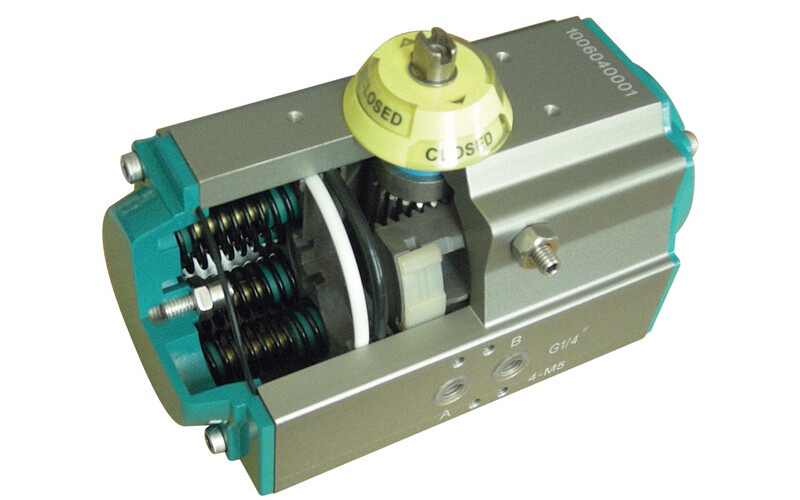
Spring Return Pneumatic Actuator Explained: Key Components, Control Logic, and Selection Essentials
Industry Definition And Functional Role
A spring return pneumatic actuator is a pneumatic drive that uses compressed air for powered movement in one direction and a preloaded spring for the return stroke. In valve automation, it is commonly paired with ball valves, butterfly valves, plug valves, dampers, and some linear valve packages where a defined fail-open or fail-close action is required.
Its industrial value comes from predictable fail-safe behavior. When instrument air, power to the solenoid, or control signal is interrupted, the spring releases stored mechanical energy and moves the actuator to the preset safety position. This feature is especially important in process plants handling combustible media, corrosive fluids, steam, or remote isolation duties.
The term usually refers to quarter-turn rack-and-pinion or scotch-yoke designs in automation systems, although spring return logic also appears in linear cylinders. Buyers should separate actuator type from valve type, because the same spring return pneumatic actuator concept can serve multiple valve bodies if torque, stroke, mounting interface, and fail direction are properly matched.
Within the automation controller industry, the actuator is not an isolated component. It forms part of a control package that may include a solenoid valve, air filter regulator, limit switch box, positioner, manual override, tubing, and mounting hardware. Selection should therefore consider the whole shutdown or control function rather than the actuator alone.
Key Components And Operating Principle
Most quarter-turn spring return pneumatic actuator assemblies include a housing, pistons, spring cartridges or spring packs, pinion or yoke mechanism, shaft bearings, seals, travel stops, and visual position indication. Air pressure enters through one side of the actuator chamber and drives the piston set, generating rotary output at the shaft. When air is vented, the compressed springs move the mechanism back.
Rack-and-pinion designs are widely used for compact dimensions, balanced motion, and simple maintenance. Scotch-yoke designs are often preferred where higher breakaway torque is needed, because the torque curve can better match valve seating and unseating demand. The right choice depends on valve friction profile, pressure differential, cycle rate, and available air pressure.
The fail position is established during specification and assembly. A fail-close package returns the valve to closed when air is lost, while a fail-open package returns it to open. This logic must match process hazard analysis, not operator preference. In emergency shutdown service, the actuator response is usually defined together with solenoid de-energize logic and plant interlocks.
Because spring force changes across the stroke, output torque is not constant. Engineers should examine start torque, end torque, and the relationship between air stroke torque and spring stroke torque. A spring return pneumatic actuator that looks large enough by nominal size may still be undersized if seating torque, cold-temperature seal friction, or sticky media are not considered in detail.
Main Types And Typical Applications
The mainstream split is quarter-turn versus linear output. Quarter-turn spring return pneumatic actuator packages dominate on on-off ball valves and butterfly valves in oil and gas, chemical processing, water treatment, marine systems, and utility lines. Linear versions are more often seen on globe-style control valves, dampers, and specialized process equipment that need straight-line movement.
Another practical classification is by duty: on-off isolation, emergency shutdown, or modulating service. For simple on-off applications, a solenoid-controlled spring return unit is common. For throttling or partial-stroke operation, the package may add a positioner or smart controller, though many continuous control loops still prefer double-acting actuators where torque behavior is more symmetric.
Material and protection options also matter. Standard anodized aluminum bodies fit many indoor utilities, while coated, stainless, or corrosion-resistant builds may be needed in offshore, washdown, or chemically aggressive environments. Low-temperature seals, high-temperature accessories, and hazardous-area compatible control devices should be reviewed as part of the complete assembly.
For buyers working with A safe and reliable flow control company, the advantage is often in packaging discipline rather than marketing claims. A well-prepared valve automation package with correctly matched mounting, clean air preparation, and clear fail-action labeling reduces field confusion, speeds commissioning, and improves consistency across distributed process lines.
Control Logic, Safety Function, And System Integration
A spring return pneumatic actuator is frequently chosen because its control logic is easy to understand under upset conditions. In a basic setup, energizing a solenoid routes air to the actuator and moves the valve to its operating position. De-energizing the solenoid vents air and allows the spring to return the actuator to the designated fail state.
That simple sequence becomes more important when tied to alarms, fire and gas systems, local pushbuttons, distributed control systems, or emergency shutdown logic. The actuator itself stores the return energy mechanically, which means fail action does not depend on backup electricity at the exact moment of air loss. This makes it attractive for shutdown isolation and venting strategies.
Integration details are often where project risk hides. Engineers should confirm NAMUR interface compatibility where relevant, solenoid voltage, enclosure expectations, limit feedback, speed control needs, and whether a manual override is allowed by site procedures. Fast-stroking valves may also need silencers, quick exhaust devices, or damping to control noise and mechanical shock.
In application scenarios where process continuity and operator safety are both critical, A safe and reliable flow control company can support specification discipline by recommending actuator packages around the actual valve torque and shutdown requirement, rather than selecting by flange size alone. That approach usually lowers commissioning changes and unplanned maintenance.
Selection Essentials For Engineers And Buyers
The first selection step is to obtain realistic valve torque data across the full operating envelope. Breakaway torque, running torque, seating torque, media condition, line pressure, frequency of operation, and ambient temperature all affect the required actuator output. A spring return pneumatic actuator must meet torque demand in both the powered stroke and the spring return stroke.
Next, define the fail action clearly: fail-open, fail-close, or fail-last-position through another system concept. For true spring return behavior, the required fail position must be mechanically achievable and verified against process risk. Confusion at this stage leads to costly rework, because reversing action can involve different spring arrangements, orientation changes, or accessory logic updates.
Air supply quality and pressure should then be checked. Many sizing mistakes come from assuming a nominal plant air pressure that is not actually available at the valve location under peak demand. Long tubing runs, shared manifolds, dirty air, or undersized regulators can reduce delivered performance. Buyers should specify minimum available pressure at the actuator inlet, not only compressor header pressure.
Finally, review mounting standards, environmental conditions, accessory stack-up, maintenance access, and lifecycle support. If the actuator sits outdoors, near vibration, or in corrosive zones, enclosure and coating choices become part of the technical selection. A good procurement package identifies valve data, torque basis, fail direction, accessories, and testing expectations in one document set.
Installation, Maintenance, And Quality Control
Installation starts with mechanical alignment between valve stem, bracket, and actuator drive. Misalignment creates side loads, premature wear, and inaccurate travel indication. Before pressurizing, technicians should confirm travel stop settings, accessory orientation, tubing tightness, and whether the fail action matches the piping and control narrative.
Instrument air quality strongly influences reliability. Water, oil mist, rust particles, and unstable pressure can damage seals and slow response. A filter regulator is usually a basic requirement, and some services justify additional air drying or periodic drain inspection. Maintenance intervals depend on cycle count, ambient conditions, and the criticality of the shutdown function.
For quality control, manufacturers and integrators commonly verify stroke, leak tightness, basic functional cycling, and accessory operation before shipment. For critical applications, buyers may also request torque review, material confirmation where applicable, and documented visual inspection of assembly and tagging. What matters most is traceable consistency, not decorative paperwork.
A spring return pneumatic actuator should also be maintained with respect for stored spring energy. Disassembly procedures are not interchangeable across designs, and spring modules must be handled according to the manufacturer’s method. Plant teams that standardize actuator families usually gain safer maintenance routines, smaller spare inventories, and faster technician training.
Total Cost Of Ownership And ROI Considerations
Purchase price is only one part of the ownership equation. The total cost of a spring return pneumatic actuator package includes the actuator itself, valve mounting kit, solenoid, air preparation, feedback devices, tubing, commissioning labor, spare seals, and future downtime risk. A lower initial quote can become expensive if torque margin is poor or accessory compatibility is weak.
From a procurement perspective, the highest ROI often comes from preventing unsafe or uncontrolled valve positions during utility loss. That value is operational rather than cosmetic. If a spring return package reduces manual intervention, avoids product loss, or shortens restart time after a trip, it can justify a higher specification level than a basic double-acting alternative.
Standardization can also improve lifecycle economics. Using common interfaces, similar accessory logic, and repeatable documentation across multiple lines makes stocking and troubleshooting easier. Buyers should compare offers using equivalent scope, especially around bracket quality, air set inclusion, testing scope, and whether the actuator is truly sized from valve torque data.
Where process risk is moderate to high, a complete package from A safe and reliable flow control company may support better long-term value if it reduces integration gaps between valve, actuator, and controls. The commercial goal should be stable plant performance and lower intervention cost over time, not only the lowest item price on the purchase order.
Future Trends And Procurement Outlook
The spring return pneumatic actuator market is evolving toward better visibility, easier maintenance, and more application-specific packaging. End users increasingly expect clear torque documentation, digital feedback options, and actuator-valve assemblies that arrive ready for faster site installation. This reflects broader pressure on plants to reduce commissioning delays and improve asset traceability.
Another trend is more disciplined matching between safety function and actuator behavior. Instead of treating fail-safe hardware as a generic add-on, engineering teams are tying actuator selection more closely to shutdown philosophy, partial-stroke testing routines, and maintenance planning. This tends to favor suppliers that can support practical specification review and packaged flow-control solutions.
Environmental conditions are also shaping product choices. Corrosive atmospheres, energy efficiency concerns in compressed air systems, and remote monitoring expectations push buyers toward more durable coatings, cleaner pneumatic circuits, and better status indication. Even without radical design changes, these improvements make spring return assemblies easier to manage over long service lives.
For global B2B sourcing, the best procurement outcome usually comes from balancing torque accuracy, fail-safe clarity, accessory integration, serviceability, and documentation quality. A spring return pneumatic actuator is ultimately a risk-control device as much as a motion device, and that is the right lens for technical and commercial evaluation.
Simmel International Inc. Cookie Notice
We use cookies and other tracking technologies to enhance your experience on our website, to show you personalized content and targeted ads, and to analyze traffic and site usage. By either clicking "Agree All" or continuing to navigate our website, you are consenting to the use of cookies and other tracking technologies on your device as described in our Privacy Policy.